Creates a set of liner transects
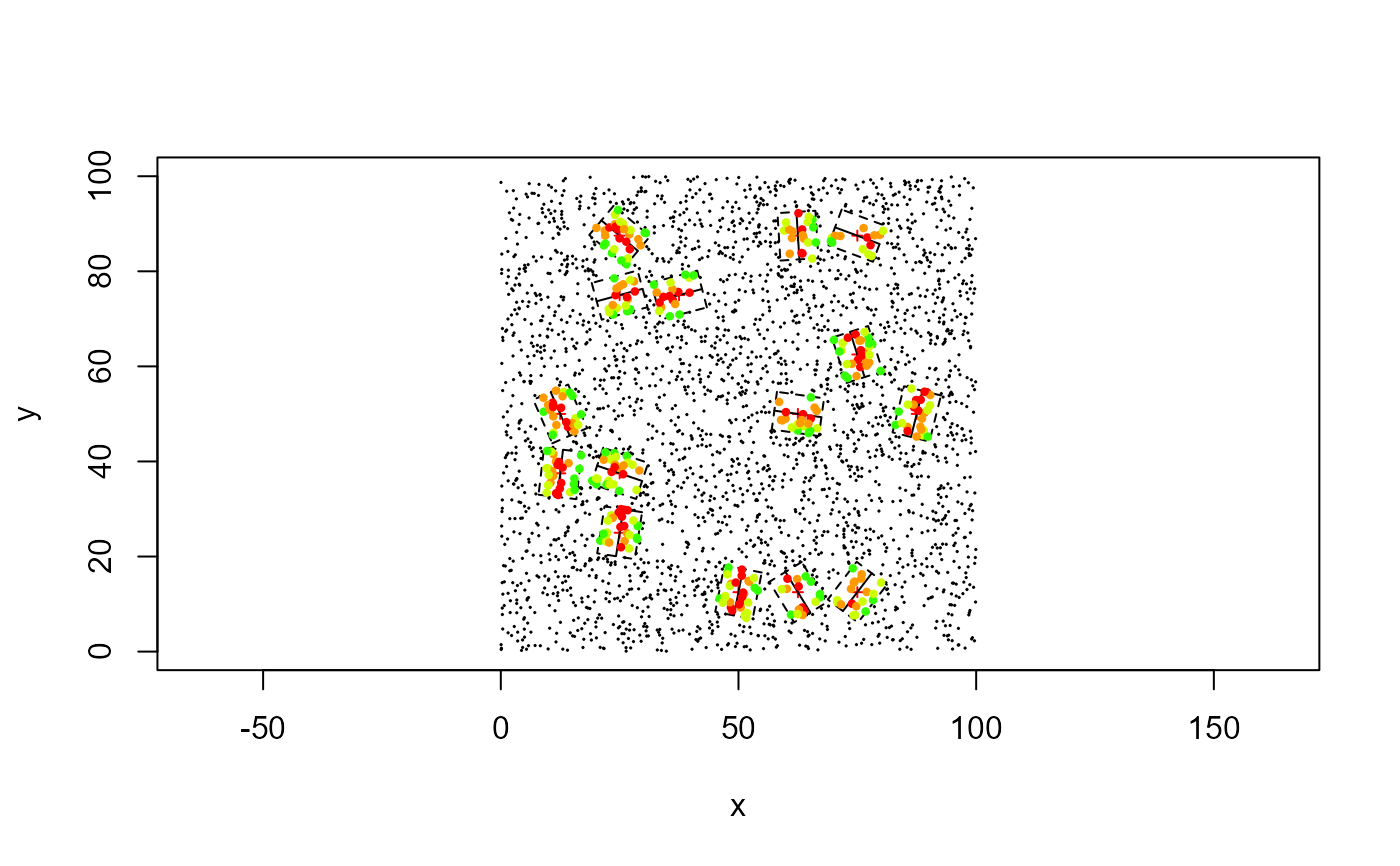
transectSample.RdCreate linear transects with random rotation or user defined rotation and centered in a set of given points and length. Returns all points at a detection range from transect line and the orthogonal distance to the transect.
transectSample(sites, occ, tlen, drng, angle="random")Arguments
- sites
Center location (x, y) for each transect centroid (in rows).
- occ
Set of points (x,y) for each individual observed.
- tlen
Total length of the transect.
- drng
Detection range for each side of the transect.
- angle
Type of angle strategy. Either 'random' (default) to get a random angle at each point, or a vector with same number of locations in 'pos', defining an angle for each location.
Details
Value
Return a list with distance Returns a list with a matrix with occ (rows) x sites (cols) with values of the orthogonal distance to the transect if detected, otherwise NA. It also contains a 'transect' list with x and y coordinates for the points of the transect and detection rectangle. x and y columns correspond to coordinates for the topleft, start, bottomleft, bottomright, end and topright points.
References
Note
See also
Examples
set.seed(1234)

#Create sampling sites with ecoforge::uniformSamp() function
sampling <- randomSamp(15, c(0,100), c(0,100), 25)

#Generate random species occurrences
sp <- data.frame(x = runif(3000, 0, 100), y = runif(3000, 0, 100))

#Create transect sampling units
tlength <- 10
drng <- 4
transect <- transectSample(sampling, sp, tlength, drng)

plot(sp, cex=0.1, asp=1)
points(sampling, cex=0.5, pch=3, col='red')

for (i in 1:nrow(sampling)) {
  pnts <- transect$transect
  lines(pnts$x[i, c(2,5)], pnts$y[i, c(2,5)])
  polygon(pnts$x[i,], pnts$y[i,], lty=2)

  d <- transect$distance[,i]
  msk <- !is.na(d)
  col <- as.integer(cut(d[msk], seq(0, drng, length.out=5)))
  points(sp[msk,], pch=16, cex=0.6, col=rainbow(10)[col])
  set.seed(1234)
}